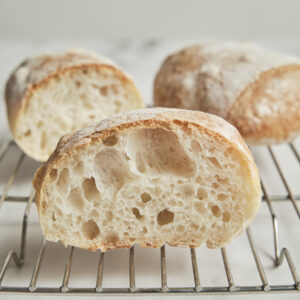
How to make Ciabatta Bread
This easy ciabatta bread recipe creates crusty, airy homemade bread with just five simple ingredients.
Ingredients
- 4 1/2 cups bread flour
- 1 tbsp extra-virgin olive oil
- 2 cups water , lukewarm
- 3 tbsp water , lukewarm
- 1 tsp active dry yeast
- 2 tsp salt
Instructions
Make the Autolyse
- In a large bowl, mix the flour with the oil and the first portion of water (395g). Stir it together with a spatula or your hands until you get a rough, firm dough. Cover it with a clean kitchen towel and let it rest for about 30 minutes—this step helps the flour fully absorb the water and sets the foundation for the dough.
Make the Dough
- After the dough has rested, mix the remaining water (50g) with the yeast and add it to the bowl along with the salt. Work it into the dough by gently pinching and pressing it through with your fingers. Then start using a stretch-and-fold motion—lift part of the dough, stretch it up, and fold it back over itself. Turn the bowl slightly and repeat, working your way around. Continue like this for about 5 minutes, until the dough starts to feel smoother and more cohesive.
- Once you’re done mixing, transfer the dough to a lightly oiled bowl or container. Cover it with a lid or a clean kitchen towel.
Proof, Stretch & Fold
- Let the dough proof for about 2 hours. During this time, do a set of stretch and folds every 30 minutes—so you’ll have four rounds in total.
- For each set, use the same motion as before: reach under the dough, lift and stretch it up, then fold it back over itself. Turn the container slightly and repeat until you’ve worked your way around the dough. Cover it again and let it rest for another 30 minutes before the next round.
Cold Proof
- Once you’ve finished all your stretch and folds, cover the bowl tightly—either with a lid or plastic wrap—and transfer it to the fridge. Let it rest overnight, or up to 24 hours for more flavor.
- When you’re ready to bake, line a tray with baking paper and dust it lightly with flour. Generously flour your work surface, then sprinkle some flour over the top of the dough as well. Gently turn it out onto the surface—the dough will be quite sticky, so don’t be shy with the flour here.
Shape the Dough
- Gently press the dough into a square, roughly 24 x 24 cm. Add a bit more flour if needed to keep it manageable. Cut it into 8 portions, then work with one piece at a time.
- Carefully transfer it to your prepared baking tray, flipping it so the floured side is now facing up. Lightly tuck the edges underneath and shape it into a loose rectangle—don’t overwork it. Repeat with the second piece, leaving enough space between them so they can rise and spread slightly.
- Loosely cover the tray with plastic wrap or a lid and let the dough rest in a warm spot for about 45 minutes to 1 hour. It should puff up slightly. To check if it’s ready, gently press it with your fingertip—if the indentation slowly springs back, you’re good to go.
Bake
- While the dough is resting, preheat your oven to 220°C / 425°F. Give it a good 20 minutes so it’s fully heated and ready to go.
- Once the dough has risen, place the tray in the oven and bake for 18–20 minutes. The ciabatta should be golden brown and sound hollow when tapped on the bottom—this is how you know it’s done.
- Take the bread out of the oven and let it sit on the tray for about 5 minutes. Then transfer it to a wire rack and allow it to cool completely before slicing.
Notes
- Check the Yeast Activity – After mixing the yeast with lukewarm water, the mixture should turn foamy and develop a light yeasty aroma. That’s how you know the yeast is active and ready to use.
- Create Steam in the Oven – Steam is the secret to ciabatta’s crispy, crackly crust. I like to place a tray of hot water on the bottom rack while the oven preheats for that bakery-style finish.
- Use a Bench Scraper – Ciabatta dough has a very high hydration, which makes it sticky and tricky to handle. A bench scraper makes shaping and transferring the dough much easier, and a little flour can help if needed.